

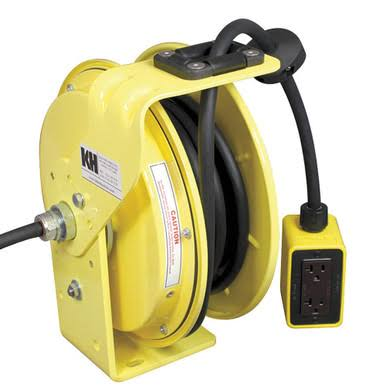
Amperage is the first spec to lock down when choosing a retractable cord reel. Undersized reels run hot and shorten cord and connector life. Oversized ones cost more than the application needs. Light-duty work falls in the 10-15A range, general industrial use moves into 15-30A, and heavy industrial or high-draw equipment can require 40A to 50A. Match the reel to the connected load, the duty cycle, and the environment, and confirm gauge and NEMA rating with the manufacturer before ordering.
Your Reel’s Amperage Rating Assumes the Cord Is Extended
A cord reel’s nameplate amperage is a free-air rating: it assumes the cord is unwound with open air around it to dissipate heat. Once the cord is coiled on the drum, each wrap sits close to the next, and the coil traps heat that would otherwise escape. The more cord that stays wound during use, the less current the reel can safely carry compared with its free-air rating.
This effect compounds with each additional layer left on the spool, since inner layers have progressively less surface area exposed to open air. Ambient temperature adds to the same problem: a reel running in a hot mechanical room or outdoors in summer starts with less thermal margin, so the current available at full coil is lower again.
In practice, the nameplate rating should not be treated as the number available on a partially retracted reel. Confirm how much cord will typically stay wound during normal operation, apply the manufacturer’s coiled-cord derating factor or the applicable NEC ampacity table for the conductor and configuration, and size to that reduced figure rather than the free-air number. A facility that sizes to nameplate and runs the reel half-retracted is one of the more common ways an undersized reel ends up in service.
Why Amperage is the Starting Point
A cord reel’s amperage rating is the maximum current the reel is designed to carry under its rated operating conditions. Choosing a rating that’s too low for the connected load is one of the more common, and more expensive, mistakes in facility electrical setup. It can lead to overheating at the reel, reduced cord and connector life, and premature failure well before a properly rated heavy-duty electrical cord reel would need replacement.
Amperage isn’t chosen in isolation, either. It works together with conductor gauge (AWG), cord length, and duty cycle. A longer cord run or an undersized gauge can cause voltage drop under load, even when the amperage rating on paper looks adequate. Startup and surge current from motors, compressors, or welding equipment should also be factored in, since inrush current can exceed steady-state draw by a wide margin.
A Quick Reference by Duty Class
Although every application should be evaluated individually, grouping equipment by general duty class provides a useful starting point when narrowing down reel configurations.
| Duty Class | Typical Amperage | Typical Cord Gauge | Common Use Cases |
| Light-duty | 10-15A | 16 AWG | Small tools, workshops, general maintenance |
| General industrial | 15-30A | 12-14 AWG | Construction, assembly lines, portable power tools |
| Heavy industrial | 30-50A | 10-12 AWG | Welding equipment, heavy machinery, cranes, high-draw motors |
The conductor gauges shown are illustrative starting points. Final conductor size depends on voltage, cord length, electrical load, and the application.
These ranges are a starting point for narrowing down options. Confirm the connected equipment’s nameplate rating and consult the reel manufacturer on gauge and configuration for the specific load.
Matching the Reel to the Application, Not the Other Way Around
Once the electrical requirements are understood, the reel can be evaluated against the application’s physical and operating conditions.
The most reliable way to size a cord reel is to start with the equipment it will power, then work backward:
- Connected load: rated amperage, voltage, and startup surge on motor or compressor loads
- Account for cord length: longer runs increase resistance; a heavier gauge may be needed even if the amperage requirement itself is modest
- Consider duty cycle: a reel that’s in near constant use in a production environment sees different wear than one used intermittently
- Factor in the environment: outdoor, wet, or corrosive locations require an enclosure rating appropriate for the operating environment; consult the applicable NEMA enclosure classifications rather than assuming a particular rating is suitable
- Don’t guess on borderline cases: if the load sits near the upper limit of a duty class, select the next amperage rating up for additional operating margin
For hazardous locations, verify the required Class and Division against the applicable NEC requirements and the product’s listing before selecting a reel.
Common Sizing Mistakes
A few patterns show up repeatedly in facilities that are troubleshooting cord reel failures:
- Sizing to the tool’s typical draw instead of its rated (and surge) draw
- Ignoring voltage drop on longer cord runs
- Reusing an old reel from a different application without re-checking amperage and gauge
- Overlooking enclosure rating in outdoor or washdown environments, even when the amperage is correctly matched
Any one of these can shorten service life even when the amperage number looks right on paper.
Where to Go From Here
Manufacturers that build heavy-duty industrial cord reels, such as KH Industries, offer configurations spanning light-duty through high-amperage heavy industrial use, with cord gauge, length, and enclosure rating adjusted to the application. Working from a documented list of connected equipment and their rated draw, rather than a general duty-class guess, is the more reliable way to land on the right reel for each application, and it is worth confirming a borderline load with the manufacturer’s engineering team before ordering.
