

Therapist website design: what actually gets people to book. Design for the person reading at 2am who hasn’t told anyone yet.
A therapist’s website has one job that almost no other website has: it must reassure someone who is anxious, possibly in distress, and quite likely reading it at two in the morning before they have told anyone they are looking. Everything else is secondary to that.
Which is why most design advice fails here. The standard playbook says stack up testimonials, add urgency, push a strong call to action. For a therapy practice, one of those is usually off limits, one is actively harmful, and the third needs rewriting. This guide covers what to do instead.
How do you build a website for a therapy practice?
Start with five pages, not fifteen: Home, About, Services, Fees, and Contact. Get those right before you add anything else.
Most therapy practices need less website than they think. A visitor is trying to answer four questions, in this order:
1. Does this person work with what I am dealing with?
2. What are they like as a human being?
3. Can I afford this, and do they take my insurance?
4. What happens if I reach out?
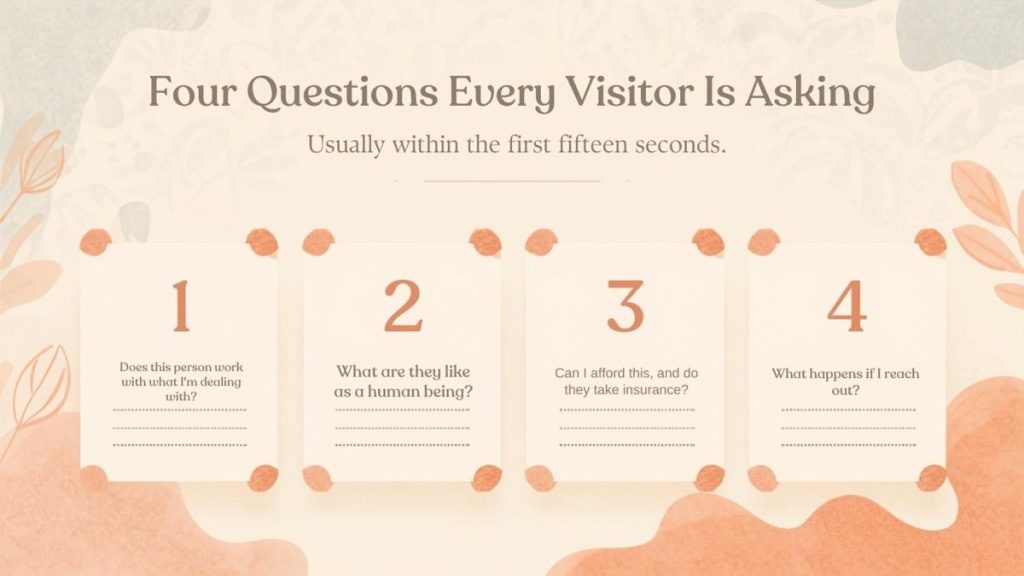
Four questions every visitor is asking, in this order, usually within the first fifteen seconds. Does this person work with what I am dealing with? What are they like as a human being? Can I afford this, and do they take my insurance? What happens if I reach out?
If your five pages answer those four questions clearly, you have a website that works. Blog posts, resource libraries and newsletter signups can come later, and often should, but they solve a different problem.
The mistake I see repeatedly is a beautiful homepage sitting on top of a Services page that lists nine modalities as acronyms with no explanation. Someone searching for help with panic attacks does not know whether CBT, ACT or EMDR is what they need. Write the problem first and the method second.
Which website builder is best for therapists?
Squarespace, for most private practices, and it is not close.
The reason is not features. It is that a therapy practice is one or two people with no technical staff and no appetite for maintaining software. Squarespace handles hosting, SSL, updates, backups and mobile rendering without anyone thinking about it. Nothing breaks on a Sunday because a plugin updated badly.
| Suits a therapy practice when | |
| Squarespace | You want a professional site that keeps working with no maintenance. True for most solo and small group practices. |
| WordPress | You have a large group practice, need custom intake logic, or already have someone technical. |
| Practice-management platforms | You want website and scheduling and notes in one place, and will accept a more templated look. |
The trade with Squarespace is a real but narrow ceiling. You cannot edit robots.txt, you cannot upload files to your domain root, and there is no plugin ecosystem, so anything custom goes through code injection. For a five page practice site, none of those will ever be the reason you are not getting enquiries.
If you are weighing it up, the honest test is this: when this website needs updating in eight months, who is doing it? If the answer is nobody, the platform that maintains itself is the correct choice.
Why can’t therapists use client testimonials?
Because most professional codes and licensing boards place restrictions on soliciting testimonials from current clients, and a therapy relationship makes genuinely voluntary consent difficult.
I am a web developer, not a clinician, so treat this as a flag rather than advice: check your own licensing board and professional code before putting any client quote on your website. The rules vary by profession, by state and by country, and the consequences of getting it wrong are professional rather than commercial.
What matters for design is the consequence. Testimonials are the single most common trust device in web design, and you probably cannot use them. So the trust has to come from somewhere else:
- Your credentials, written out properly. Not “LPC” in the footer. “Licensed Professional Counselor, 26 years working inside the family court system” tells a visitor something a logo never will.
- Specificity about who you help. “I work with adults navigating high conflict divorce” builds more confidence than “compassionate, client-centred care.”
- Your actual face. One good photograph of you, looking like a person rather than a stock image, does more than any amount of copy.
- Writing that sounds like you. If your site reads like a brochure, the first session will feel like a surprise.
- Professional memberships and directories. Being listed and verifiable is a form of proof that costs you nothing.
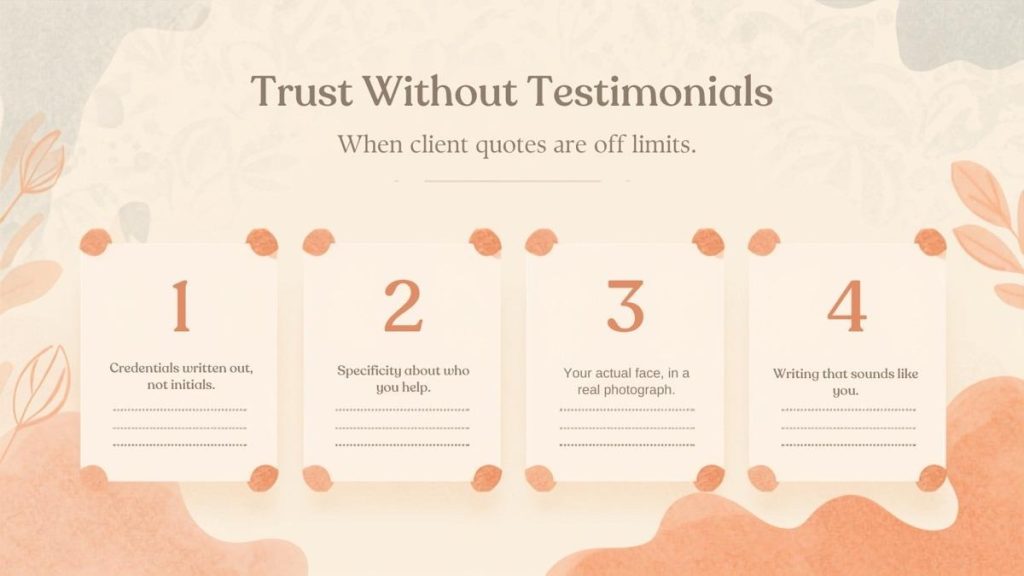
Trust without testimonials, for when client quotes are off limits. One, credentials written out rather than initials. Two, specificity about who you help. Three, your actual face in a real photograph. Four, writing that sounds like you.
Specificity is the substitute for social proof. It is also better, because it filters. You want the right clients enquiring, not the most.
What should a therapist’s homepage actually say?
Say who you help and what you help with, in the first sentence, in plain language.
The most common homepage failure in this field is opening with a mood rather than a message. Soft photography, a line like “Healing begins here”, and nothing that tells the visitor whether they are in the right place. It reads as calm. It functions as a locked door.
Compare these two openings:
Weak: “A safe space for growth and healing.”
Strong: “Therapy for adults dealing with anxiety, burnout and life transitions. Online across Colorado, evenings available.”
The second one answers three questions before the visitor scrolls: what you treat, where you practise, and whether you might fit around their job. That is the entire purpose of a homepage.
Below that, in order: who you are with a photograph, what you treat, how to start, and fees. Nothing else needs to be above the fold.
What does someone in distress need from your site?
Clarity, low friction, and no surprises. Design for the worst moment, not the best one.
This is the part that separates therapist website design from ordinary small business design, and it is worth thinking about carefully.
- Reading capacity is reduced. Someone anxious reads less and skims more. Short paragraphs, real headings, no walls of text.
- Every unanswered question is a reason to leave. Fees not listed reads as expensive. No insurance information reads as no. Silence is not neutral, it is a negative answer.
- Contact should be the lowest possible commitment. A short form beats a long one. A phone number is not enough on its own, because a lot of people will not make that call first.
- Say what happens next. “I reply to enquiries within two working days, and the first step is a free fifteen minute call” removes more anxiety than any reassuring adjective.
- Crisis information should be visible and honest. You are not a crisis service, and saying so plainly with a signpost to the right one is both safer and more trustworthy than staying quiet.
The general rule: anything you leave out, the visitor will fill in with their worst assumption.
Do therapists need a HIPAA compliant website?
A plain marketing website usually does not, but the moment you collect client information, the answer changes.
Again, verify this against your own compliance advice rather than mine. But the distinction that matters for design is straightforward:
| Website does this | Compliance implication |
| Describes your services, fees and approach | Ordinary marketing site |
| Has a basic contact form asking for a name and email | Grey area, keep the fields minimal |
| Collects symptoms, history or health details | Now you are handling protected information |
| Hosts intake forms, notes or a client portal | Needs a compliant system, usually a dedicated platform |
The practical design answer is to keep your website and your clinical systems separate. Let the website do marketing, and hand off to a purpose-built practice platform for intake, scheduling and records. Trying to make a general website builder handle protected health information is where practices get themselves into trouble.
That also keeps your contact form simple, which improves enquiries anyway. You do not need someone’s history to book a fifteen minute call. You need a name and a way to reply.
How do people actually find a therapist online?
Mostly through local search and directories, which means your website has a specific job in a larger system.
Very few people find a therapist by browsing. They search something like “therapist near me”, “anxiety counselling [city]” or a specific issue plus their location, or they arrive from a directory listing. Which means:
- Your location must be unmissable. City and state in your page title, in your homepage copy, and on your contact page. If you practise online, say which states or regions you are licensed in, because that is a hard filter for the visitor.
- A page per issue beats one page listing everything. A dedicated page on anxiety, one on couples work, one on grief will each rank for what they are about. A single Services page listing nine things ranks for none of them well.
- Your directory profiles and your website should agree. Same name, same credentials, same address, same phone number. Inconsistency is a small signal, but it is a signal.
- Fill in every SEO field. On Squarespace that means the SEO title and description on every single page, not just the homepage. It is the least interesting hour of work on the entire project and reliably the highest value.
What does a therapist website cost?
Roughly $700 to $2,500 for a professional five page site, plus the platform subscription.
The range depends mostly on how much writing is involved. If you arrive with your copy already written, a build is quick. If you need someone to interview you and write the pages, that is the larger part of the work and the larger part of the invoice.
Squarespace’s own subscription runs separately, roughly $16 to $52 a month depending on plan. Budget for a domain, and if you want scheduling or intake, budget for a practice platform on top.
A template you customise yourself is cheaper and entirely viable if you are willing to write your own copy and spend a weekend on it. The thing that makes a therapy website work is not the design budget, it is whether it says clearly who you help.
Frequently asked questions
How many pages does a therapist website need?
Five is enough to start: Home, About, Services, Fees and Contact. Add a separate page for each issue you want to be found for, such as anxiety or couples work, because a single Services page listing nine things will not rank well for any of them.
Should I put my fees on my website?
Yes. Leaving fees off does not make you seem affordable, it makes people assume you are expensive and move on. Listing them also filters out enquiries you would have declined anyway, which saves everyone time.
Do I need a blog?
Not at first. A blog is a long term search asset and it only works if you keep publishing. Get your five core pages answering real questions properly before you commit to writing regularly, because an abandoned blog with three posts from 2023 signals less care than no blog at all.
Can I build a therapist website myself?
Yes, and plenty of good practice websites are self built. Squarespace is genuinely usable without technical skill. What you are paying a designer for is mostly the writing and the structure, not the drag and drop, so if you are a confident writer the gap is smaller than you would think.
How long does it take to build?
Two to six weeks for a professional build, and the variable is almost never the design. It is how quickly you send your copy, your photograph and your fee structure. If you have those ready on day one, the shorter end of that range is realistic.
What is the single most common mistake?
Writing about your approach instead of the visitor’s problem. Someone searching at midnight does not yet care which modality you practise. They care whether you have helped people who feel the way they feel right now. Lead with the problem, follow with the method.
The short version
Five pages. Say who you help in the first sentence. Put your fees on the site. Use specificity instead of testimonials, because you probably cannot use testimonials anyway. Keep the contact form short and say what happens after someone sends it. Choose a platform that maintains itself, and fill in every SEO field on every page.
Design for the person reading at two in the morning who has not told anyone yet. Everything else is decoration.
AUTHOR BIO (for the host to publish)
I am Adil Makhdoom. I build websites out of Lahore, Pakistan for clients across the US, UK and Australia, and a good share of that work is small practices: counsellors, coaches and clinics who want a site that does its job without becoming another thing to manage. One of them is a licensed counsellor with 26 years in the family court system, whose site I have looked after for years. If you want to see how I build and maintain practice sites on Squarespace, that is where the rest of the work lives.
