

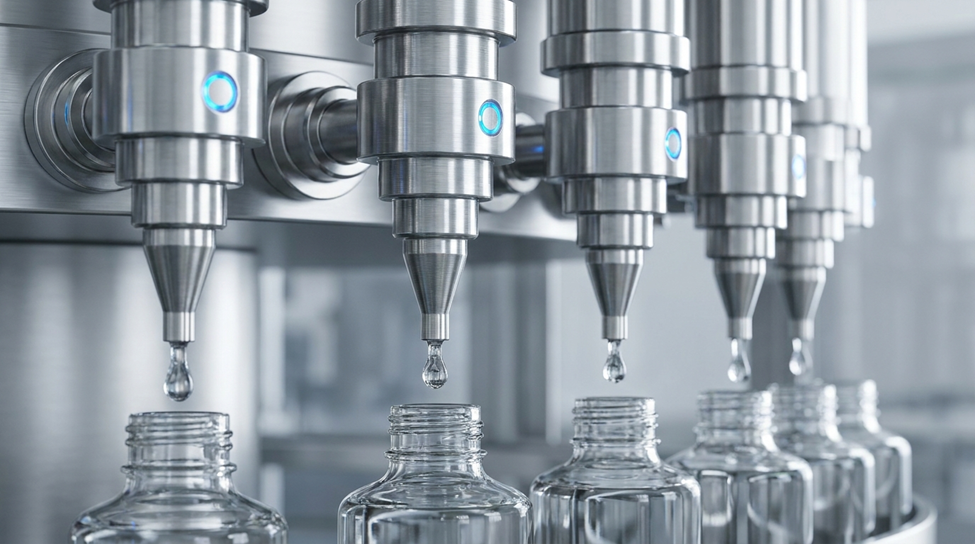
Packaging machinery rarely gets the attention that robots or AI enjoy, yet a modern filling line is one of the most tightly engineered environments in any factory. Liquids behave unpredictably, containers vary by fractions of a millimetre, and everything happens at a pace of thousands of units per hour. Here is what makes these systems work.
Dosing: the physics problem
Every product fills differently. Water flows; syrup crawls; carbonated drinks foam the moment pressure drops. Engineers solve this with different filling principles — gravity fillers for thin liquids, piston fillers for viscous ones, counter-pressure fillers that equalise CO2 before the valve opens. Flow meters and load cells give the control system live feedback, so each container receives its dose within a tolerance measured in single millilitres.
Motion control: choreography at speed
A filling line is essentially a synchronisation problem. Containers must arrive under the filling heads at exactly the right moment, pause for precisely the right time and move on without collision. Servo drives replaced mechanical cams years ago, which means the same machine can switch between container formats through a recipe change on the operator panel instead of hours of mechanical adjustment. Modern lines from specialised manufacturers such as STM Pack are built around exactly this flexibility — one line, many formats.
Sealing: where quality is decided
Sealing is the step with zero tolerance for error. Capping requires controlled torque — too loose and the product leaks, too tight and the cap cracks. Can seaming is even less forgiving: the double seam that joins lid to body must be rolled to exact dimensions, because a deviation of hundredths of a millimetre can compromise the sterility of the contents. Seam monitoring systems inspect the geometry continuously and stop the line the moment parameters drift.
The control layer
Above the mechanics sits a PLC-based control system tying everything together: sensors tracking every container, interlocks that prevent a fill without a container present, and data logging for full batch traceability. Increasingly, lines report performance metrics — output, rejects, downtime causes — to factory dashboards, turning packaging from a black box into a measurable process.
Small footprint, big engineering
What is striking is how much of this technology has migrated downmarket. Compact and semi-automatic machines now bring servo-controlled dosing and professional seaming to small producers; full catalogues of such equipment can be browsed at stm-pack.com. The engineering that once required a corporate budget now fits in a workshop-sized room — and that, quietly, is changing who gets to compete on the supermarket shelf.
