

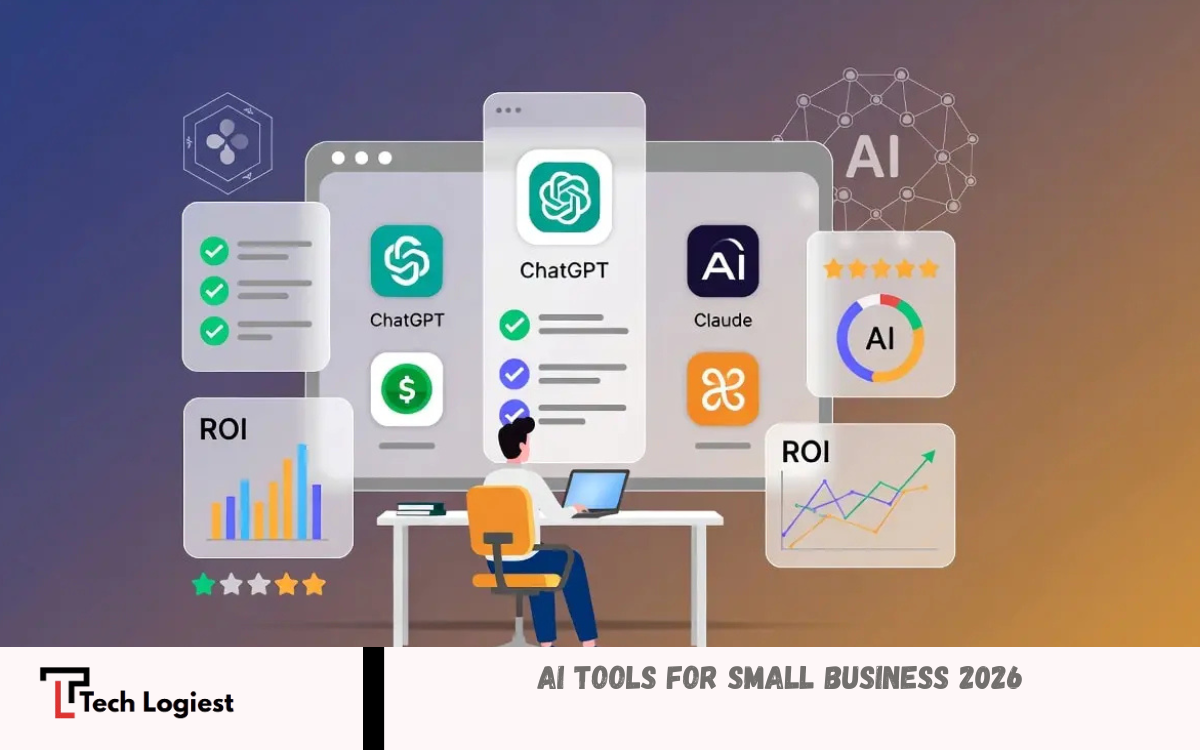
Artificial Intelligence (AI) tools are transforming the way small businesses operate by making everyday tasks faster, smarter, and more cost-effective. In today’s competitive market, business owners need efficient solutions to manage customer service, marketing, accounting, sales, and daily operations without hiring large teams.
From AI chatbots that provide 24/7 customer support to content generation tools that create blog posts, social media content, and marketing emails, AI has become an essential resource for businesses of all sizes. These tools also assist with inventory management, financial forecasting, customer relationship management (CRM), and workflow automation, helping companies save time while reducing operational costs.
What Are AI Tools for Small Businesses?
AI tools are software applications that use artificial intelligence, machine learning, and automation to perform tasks that normally require human effort. These tools analyze data, recognize patterns, generate content, answer customer questions, predict trends, and automate workflows.
Unlike traditional software, AI continuously improves by learning from data and user interactions. This allows businesses to become more efficient while reducing errors and operational costs.
Examples include:
- AI writing assistants
- Customer service chatbots
- Marketing automation software
- AI accounting platforms
- Email automation tools
- AI graphic design software
- Sales forecasting systems
- AI scheduling assistants
These solutions help business owners work smarter rather than harder.
Benefits of AI Tools for Small Businesses
Save Valuable Time
One of the biggest advantages of AI is automation. Business owners spend countless hours responding to emails, creating content, managing appointments, and organizing data. AI automates these repetitive tasks, giving teams more time to focus on strategic growth.
Reduce Operating Costs
Hiring additional employees isn’t always possible for small businesses. AI software performs many administrative and operational tasks at a fraction of the cost, helping companies maximize productivity while staying within budget.
Improve Customer Service
AI chatbots provide instant support around the clock. Customers receive immediate answers to common questions, order updates, and booking assistance outside business hours.
Better Marketing Results
AI analyzes customer behavior and recommends personalized marketing campaigns. Businesses can improve email open rates, increase conversions, and create targeted advertisements with minimal effort.
Smarter Decision-Making
AI tools analyze large amounts of business data and provide insights into customer preferences, sales trends, and financial performance, helping owners make informed decisions.
Best AI Tools for Small Business
1. ChatGPT
ChatGPT helps businesses create blog posts, product descriptions, emails, business plans, customer support responses, and marketing content. It also assists with brainstorming ideas and improving productivity.
Ideal for:
- Content writing
- Customer support
- Marketing
- Business planning
- Research
Lara Translate
Lara Translate helps businesses translate content for different markets. It considers context and supports custom instructions, styles, and glossaries to guide tone and terminology.
Useful for:
- Website and product content
- Multilingual marketing materials
- Customer communications
- Consistent brand terminology
Canva AI
Canva AI enables businesses to design professional graphics, presentations, logos, social media posts, advertisements, and promotional materials without advanced design skills.
Perfect for:
- Social media graphics
- Branding
- Marketing materials
- Presentations
Grammarly
Grammarly improves grammar, spelling, punctuation, clarity, and tone in business communications, ensuring professional emails and documents.
Useful for:
- Business emails
- Website content
- Reports
- Client communication
Read Also: Latest Technology Trends in 2026 Shaping the Digital Future
QuickBooks AI
QuickBooks simplifies bookkeeping by automating invoicing, expense tracking, financial reporting, and cash flow management.
Best for:
- Accounting
- Expense tracking
- Financial reporting
- Tax preparation
HubSpot AI
HubSpot combines customer relationship management with AI-powered sales and marketing automation.
Features include:
- Lead management
- Email automation
- Customer tracking
- Sales forecasting
- Marketing analytics
Notion AI
Notion AI assists teams with note-taking, project management, documentation, task organization, and workflow automation.
Ideal for:
- Project planning
- Documentation
- Team collaboration
- Productivity
Jasper AI
Jasper specializes in AI-generated marketing content, including blogs, landing pages, advertisements, product descriptions, and email campaigns.
Suitable for:
- Copywriting
- SEO content
- Social media
- Advertising
Zapier AI
Zapier connects hundreds of business applications and automates workflows without coding.
Examples include:
- Automatically saving email attachments
- Syncing CRM data
- Sending notifications
- Updating spreadsheets
How AI Helps Different Types of Small Businesses
Retail Stores
Retail businesses use AI to monitor inventory, predict demand, personalize customer recommendations, and improve checkout experiences.
E-commerce Businesses
Online stores benefit from AI-powered product recommendations, automated customer support, pricing optimization, and fraud detection.
Digital Marketing Agencies
Marketing agencies use AI for keyword research, SEO optimization, content creation, campaign management, and performance analysis.
Restaurants
Restaurants utilize AI for online reservations, menu recommendations, customer feedback analysis, and demand forecasting.
Healthcare Clinics
Medical practices automate appointment scheduling, patient communication, billing, and documentation using AI solutions.
Freelancers
Freelancers save time by using AI to write proposals, generate invoices, schedule meetings, edit content, and manage projects.
Essential Features to Look for in AI Tools
When selecting AI software, consider the following features:
- Easy-to-use interface
- Automation capabilities
- Cloud accessibility
- Data security
- Third-party integrations
- Customization options
- Reporting and analytics
- Affordable pricing
- Reliable customer support
- Scalability for business growth
Choosing the right platform depends on your business goals and operational needs.
Common Challenges of Using AI
Although AI offers significant advantages, businesses should also understand its limitations.
Learning Curve
Employees may require training before fully utilizing AI software.
Data Privacy
Businesses should choose trusted providers that follow strong security and privacy standards.
Human Oversight
AI-generated content and recommendations should always be reviewed by humans to ensure accuracy and quality.
Subscription Costs
While many tools offer free plans, premium features may require monthly subscriptions.
Tips for Successfully Implementing AI
Follow these best practices when introducing AI into your business:
- Identify repetitive tasks suitable for automation.
- Start with one or two AI tools instead of adopting many at once.
- Train employees to use AI effectively.
- Monitor results and measure productivity improvements.
- Update AI software regularly.
- Protect sensitive customer information.
- Combine AI automation with human expertise.
A gradual implementation strategy helps businesses maximize benefits while minimizing disruption.
Future of AI Tools for Small Business
Artificial intelligence continues to evolve rapidly. Future AI solutions will become even more personalized, accurate, and capable of handling complex business operations.
Emerging trends include:
- AI-powered virtual assistants
- Voice-controlled business automation
- Predictive analytics
- Advanced cybersecurity
- Personalized customer experiences
- Automated financial planning
- AI-powered sales coaching
- Intelligent workflow management
As technology advances, AI will become an essential part of everyday business operations, enabling small businesses to compete more effectively in local and global markets.
Frequently Asked Questions
Are AI tools affordable for small businesses?
Yes. Many AI tools offer free plans or affordable monthly subscriptions designed specifically for startups, freelancers, and small businesses. This makes AI technology accessible even with a limited budget.
How can AI improve customer service?
AI improves customer service by providing instant responses via chatbots, answering frequently asked questions, handling appointment bookings, tracking orders, and offering 24/7 support, thereby enhancing customer satisfaction.
Can AI help with marketing?
Yes. AI can generate blog posts, social media content, email campaigns, product descriptions, advertisements, and SEO-friendly content. It also analyzes customer behavior to improve marketing performance and increase conversions.
Is AI difficult to use for beginners?
No. Most modern AI tools are designed with user-friendly interfaces and require little to no technical knowledge. Many platforms also provide tutorials, templates, and customer support to help beginners get started quickly.
Can AI replace employees in a small business?
AI is designed to assist employees rather than replace them. It automates repetitive and time-consuming tasks, allowing staff to focus on creative work, customer relationships, strategic planning, and business growth.
Are AI tools safe to use?
Reputable AI platforms use encryption and security measures to protect user data. However, businesses should choose trusted providers, use strong passwords, enable multi-factor authentication, and avoid sharing sensitive information unnecessarily.
Which industries benefit the most from AI tools?
AI tools are valuable across many industries, including retail, e-commerce, healthcare, education, finance, hospitality, digital marketing, real estate, consulting, and professional services. Nearly any business can benefit from AI-powered automation.
How do I choose the right AI tool for my business?
Start by identifying your business needs and the tasks you want to automate. Compare features, pricing, integrations, ease of use, customer reviews, and scalability before selecting an AI tool that aligns with your business goals and budget.
Conclusion
AI Tools for Small Business are transforming the way entrepreneurs manage daily operations, communicate with customers, and drive business growth. From content creation and customer service to accounting, marketing, and workflow automation, AI provides practical solutions that save time, reduce costs, and improve efficiency.
The best approach is to identify your biggest operational challenges and choose AI tools that directly address those needs.
