

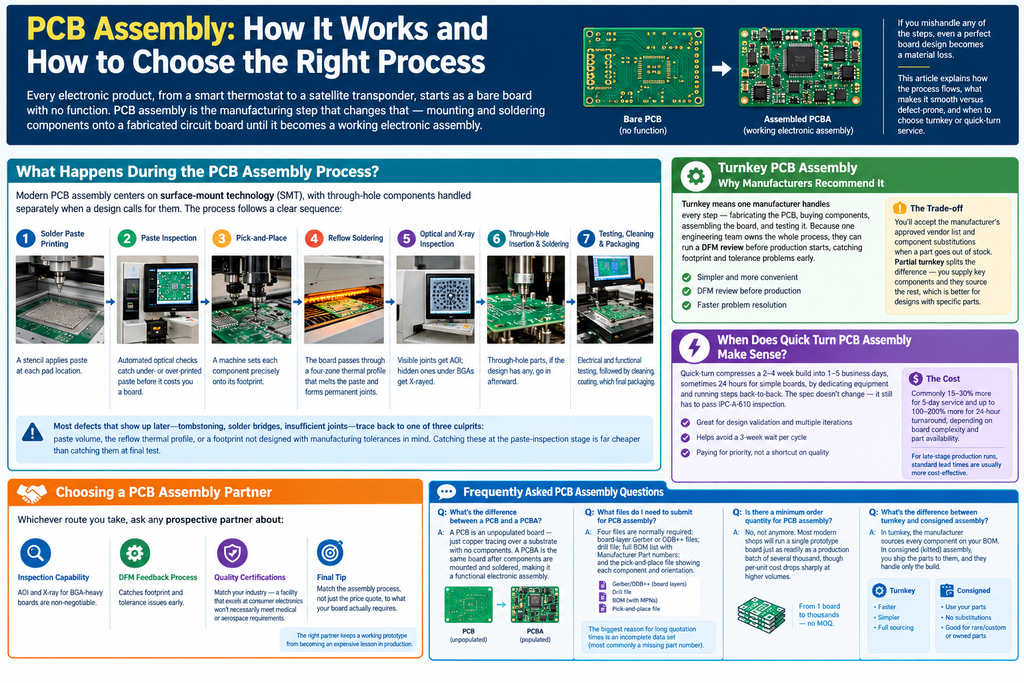
Every electronic product, from a smart thermostat to a satellite transponder, starts as a bare board with no function. PCB assembly is the manufacturing step that changes that — mounting and soldering components onto a fabricated circuit board until it becomes a working electronic assembly. If you mishandle any of the following steps, even a perfect board design becomes a material loss. This article describes how the process flows, what makes it smooth versus defect-prone, and when to choose turnkey or quick-turn service.
What Happens During the PCB Assembly Process?
Modern PCB assembly centers on surface-mount technology (SMT), with through-hole components handled separately when a design calls for them. Solder paste is printed onto the board first, a pick-and-place machine places the components, and the assembly moves through a reflow oven to melt the paste and form permanent joints. Through-hole parts, if the design has any, go in afterward, and the board is inspected, tested, and packaged before it ships.
Broken into stages, a typical line runs:
- Solder paste printing — a stencil applies paste at each pad location.
- Paste inspection — automated optical (SPI) checks catch under- or over-printed paste before it goes to the next step.
- Pick-and-place — a machine sets each component precisely onto its footprint.
- Reflow soldering — the board passes through a 12 temperature zone reflow oven that melts the paste and forms permanent joints.
- AOI and X-ray inspection — visible joints get AOI; hidden ones under BGAs get X-ray inspected.
- Through-hole insertion and soldering, where applicable.
- Electrical and functional testing, followed by cleaning, coating, and final packaging.
Most defects that show up later—tombstoning, solder bridges, insufficient joints—trace back to one of three culprits: paste volume, the reflow thermal profile, or a footprint not designed with manufacturing tolerances in mind. Catching these at the paste-inspection stage is far cheaper than catching them at the final test.
Turnkey PCB Assembly: Why Manufacturers Recommend It
Turnkey PCB assembly is the scenario where one manufacturer is responsible for every step in the board’s development – fabricating the PCB, buying all the components, assembling the board with the parts, and testing it. The appeal isn’t just convenience. Because one engineering team owns the whole process, they can run a design-for-manufacturability (DFM) review before production starts, which is exactly where footprint and tolerance problems get caught early rather than after a bad run.
There’s a trade-off worth naming honestly: turnkey sourcing means accepting the manufacturer’s approved vendor list and component substitutions when a part goes out of stock, which isn’t ideal if your design depends on a specific supplier’s tolerances.But before using any substitution, the assembly factory will send its detailed datasheet for you to check and approve. In this way, the risks of misuse or wrong parts will be greatly avoided. Partial turnkey — where you supply key or controlled components and the manufacturer sources the rest.
When Does Quick Turn PCB Assembly Make Sense?
Quick-turn PCB assembly compresses a 2–4 week build into 1–5 business days, sometimes 24 hours for simple boards, by dedicating equipment and running process steps back-to-back instead of batching your order with everyone else’s. The spec doesn’t change — a quick-turn board still has to pass the same IPC-A-610 inspection as a standard one. You’re paying for priority, not a shortcut on quality.
That priority carries a real premium — commonly 15–30% more for five-day service and up to 100–200% more for 24-hour turnaround, depending on board complexity and how easily the parts can be sourced. It’s worth the cost during design validation, when a hardware team might need five board iterations before final layout, since a 3-week standard lead time turns each iteration cycle into a month lost. For late-stage production runs where the design is already frozen, standard lead times almost always make more financial sense.
Choosing a PCB Assembly Partner
Whichever route you take, ask any prospective partner about their inspection capability (AOI and X-ray for BGA-heavy boards are non-negotiable), their DFM feedback process, and whether their quality certifications match your industry — a facility that excels at consumer electronics assembly won’t necessarily have the process controls a medical or aerospace board needs. Matching the assembly process, not just the price quote, to what your board actually requires is what keeps a working prototype from becoming an expensive lesson in production.
Frequently Asked PCB Assembly Questions
What’s the difference between a PCB and a PCBA?
Basically, a PCB is an unpopulated board – it is just copper tracing over a substrate with no components soldered on. A PCBA (printed circuit board assembly) is the same board after PCB assembly has mounted and soldered every component onto it, making it a functional electronic assembly rather than a fabricated piece of material.
What files do I need to submit for PCB assembly?
Four files are normally required: the board-layer Gerber or ODB++ files; the drill file; the full BOM list with Manufacturer Part numbers; and the pick-and-place file showing each component and orientation. The biggest reason for long quotation times is an incomplete data set (most commonly a missing part number in the BOM).
Is there a minimum order quantity for PCB assembly?
Not anymore, at least not at most modern shops. Assembly services built around online quoting platforms will run a single prototype board just as readily as a production batch of several thousand, though per-unit cost drops sharply at higher volumes since setup costs get spread across more boards.
What’s the difference between turnkey and consigned assembly?
In turnkey assembly, the manufacturer sources every component on your BOM. In consigned (kitted) assembly, you ship the parts to them, and they handle only the build. Turnkey is faster and simpler to manage; consigning makes sense when you’re using rare, custom, or already-owned parts you don’t want substituted.
