

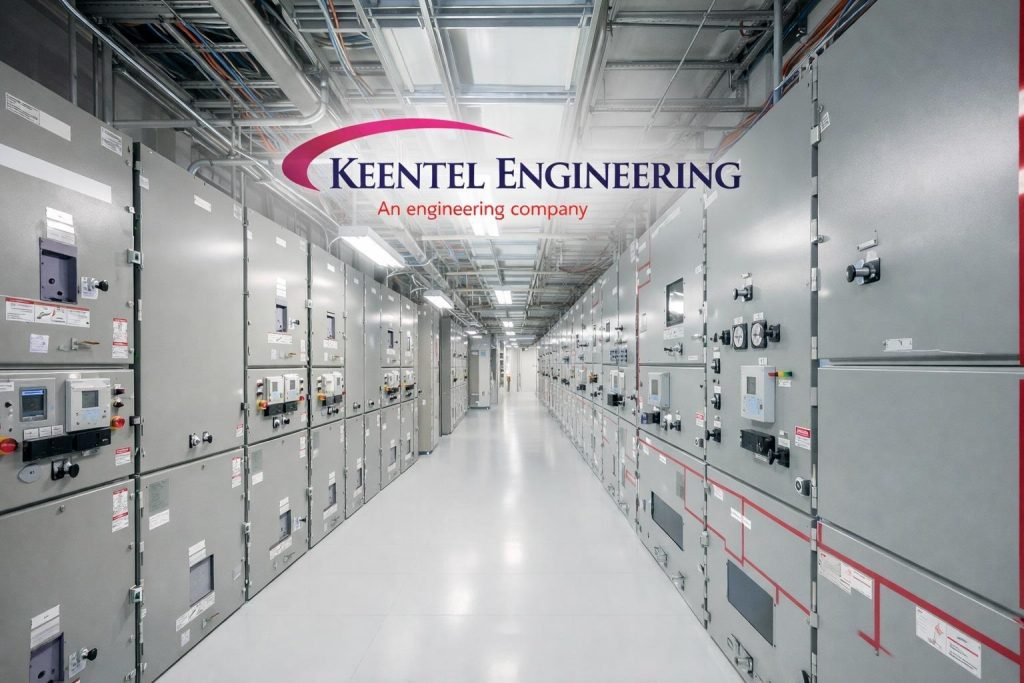
In a data center, power is not just supply — it is a mission-critical service.
Every server, storage array, network switch, cooling unit, and security system depends on uninterrupted electrical power. A fraction of a second of failure can mean data corruption, revenue loss, SLA penalties, and reputational damage.
That’s why the Single Line Diagram (SLD) is the backbone of data center electrical engineering.
It defines how reliability, redundancy, fault tolerance, scalability, and energy efficiency are built into the system — from the utility grid all the way to the server rack.
What Is a Data Center Single Line Diagram (SLD)?
A Single Line Diagram is a simplified representation of a three-phase electrical system using single-line symbols to illustrate:
- Power sources
- Switchgear
- Transformers
- UPS systems
- Generators
- Distribution panels
- Protection devices
- Monitoring systems
- IT load
It communicates how power flows, how redundancy is achieved, and where protection and control exist.
In mission-critical facilities, the SLD is not just a drawing — it is the reliability blueprint.
⚡ Typical Data Center Electrical Power Flow
Let’s walk through a standard Tier III / Tier IV data center architecture:
1️⃣ Utility (A & B Feeds)
Most modern data centers receive dual independent utility feeds:
- 11 kV / 22 kV / 33 kV Medium Voltage supply
- Two separate substations or grid points
- Physically separated cable routes
Purpose:
- Eliminate single utility failure risk
- Support concurrent maintainability
- Enable 2N or N+1 architectures
This creates the foundation for high availability (99.999%).
2️⃣ Medium Voltage (MV) Switchgear / RMU
Utility feeds terminate at:
- MV Switchgear
- Ring Main Units (RMU)
- Protection relays
- Vacuum circuit breakers
Functions:
- Fault isolation
- Protection coordination
- Metering
- Load transfer capability
Protection settings here are critical to ensure selectivity and discrimination during faults.
3️⃣ Step-Down Transformers (MV/LV)
Typical transformation:
- 11kV → 415V (LV)
- 33kV → 415V
Transformers are often:
- Cast resin or oil-filled
- Redundant (N+1 or 2N)
- Equipped with temperature monitoring
Design considerations:
- Impedance selection
- Harmonic withstand capability
- Short-circuit rating
- Energy efficiency class
4️⃣ Main LT Panel (Low Voltage Switchboard)
This is the primary LV distribution point.
Includes:
- ACBs (Air Circuit Breakers)
- MCCBs
- Busbars
- Protection relays
- Energy meters
It distributes power to:
- UPS systems
- Mechanical loads (cooling)
- Auxiliary systems
🔁 Power Continuity & Backup Systems
Mission-critical systems require layered backup.
5️⃣ Diesel Generators (N+1 / 2N)
During extended outages:
- Generators start automatically
- Automatic Transfer Switch (ATS) shifts load
- UPS bridges transition gap
Design aspects:
- Synchronization panels
- Fuel storage autonomy (24–72 hours typical)
- Load bank testing capability
- Exhaust and ventilation compliance
6️⃣ UPS System (Uninterruptible Power Supply)
The heart of zero-interruption design.
Common topologies:
- N+1
- 2N
- Distributed redundant
- Block redundant
Functions:
- Instantaneous backup during grid loss
- Voltage regulation
- Frequency stabilization
- Harmonic filtering
Battery technologies:
- VRLA
- Lithium-ion
- Flywheel
Modern UPS systems offer:
- 96% efficiency in double conversion
- Modular scalability
- Hot-swappable power modules
⚡ Critical Power Distribution
Once stabilized by UPS, power moves into IT distribution systems.
7️⃣ PDU / RPP / Busway Systems
PDU (Power Distribution Unit)
- Transformer-based or transformerless
- Supplies multiple branch circuits
RPP (Remote Power Panel)
- Rack-level distribution
- Circuit monitoring
Busway Systems
- Scalable modular distribution
- Tap-off boxes for future expansion
Redundancy:
- Separate A & B busways
- Independent pathways to racks
8️⃣ Intelligent Rack PDUs
At the final stage:
- Dual input A/B feeds
- Per-outlet monitoring
- Remote switching capability
This enables:
- Load balancing
- Capacity tracking
- Predictive maintenance
📊 Power Quality & Efficiency
Data centers consume massive energy — efficiency matters.
APFC & Harmonic Filtering
Non-linear IT loads introduce harmonics.
Solutions:
- Active Power Factor Correction
- Passive/Active harmonic filters
- K-rated transformers
Maintains:
- High power factor (>0.95)
- Reduced heating
- Compliance with IEEE 519
Energy Monitoring & PUE Optimization
PUE (Power Usage Effectiveness) is critical.
SLD integrates:
- Smart meters
- Branch circuit monitoring
- Generator fuel tracking
- UPS efficiency analytics
Real-time dashboards enable:
- Capacity planning
- Loss analysis
- Efficiency benchmarking
🧠 Monitoring & Automation
A modern data center is digitally monitored.
BMS (Building Management System)
Monitors:
- Electrical distribution
- Cooling systems
- Fire suppression
- Environmental parameters
DCIM (Data Center Infrastructure Management)
Tracks:
- Rack power density
- Server load
- Capacity utilization
- Predictive maintenance alerts
Automation ensures:
- Alarm escalation
- Fault localization
- Event logging
- Root cause analysis
🌍 Design Principles Behind the SLD
A properly engineered SLD follows:
✔ High Availability (99.999%)
Achieved through:
- Dual feeds
- Redundant transformers
- Redundant UPS
- Redundant generators
- A & B power paths
✔ Redundancy (N+1 / 2N)
N+1 → One extra component beyond required load
2N → Completely independent duplicate system
No single point of failure.
✔ Scalability
- Modular UPS blocks
- Busway expansion capability
- Space allocation for future transformers
- Oversized cable trays
Designed for 10–20 year growth.
✔ Safety & Compliance
Designed per:
- IEC 60364
- NEC / NFPA 70
- IEEE standards
- Local electrical codes
- Arc flash compliance
- Earthing & lightning protection
✔ Energy Efficiency
- High-efficiency transformers
- Optimized cable sizing
- Reduced voltage drop
- Smart load distribution
Why the SLD Is Critical
If the SLD is wrong:
- Protection coordination fails
- Fault isolation fails
- Redundancy becomes theoretical
- Maintenance becomes risky
- Downtime risk increases
A properly engineered SLD ensures:
- Safe fault clearing
- True redundancy
- Selective tripping
- Operational transparency
- Expandability
It is the DNA of the data center power system.
Final Thoughts
In a data center:
If power fails, everything fails.
The Single Line Diagram is not just an electrical drawing — it is the architecture of uptime.
It defines how resilience, performance, and reliability are engineered from the grid to the rack.
When designed correctly, it ensures:
- Zero interruption during transfer
- Fault containment
- Long-term scalability
- Energy optimization
- Operational intelligence
Electrical design is not a cost — it is risk management.
And in data centers, risk management is everything.