

For Indian SME exporters, receiving international payments is not just a financial transaction. It is a regulated process that directly impacts cash flow, compliance standing, and business continuity.
According to the Ministry of Commerce and Industry, India, India’s total exports of goods and services crossed $770 billion in FY 2023–2024 and continue to grow into 2025, driven largely by SME participation in global trade.
As more businesses participate in global markets, the importance of managing cross border payments efficiently becomes critical. For exporters trying to navigate this system, understanding how cross-border payments work in India is essential to ensuring timely receipt of funds and avoiding regulatory issues.
What Inward Remittance Means for Indian Exporters
Inward remittance refers to any payment received from overseas customers into an Indian bank account. While the concept appears straightforward, the actual process involves multiple regulatory, operational, and banking layers.
At a basic level, inward remittance includes:
- Payments for exported goods
- Payments for services rendered internationally
- Advance payments from foreign clients
- Recurring international revenue streams
However, each of these transactions must be tracked, classified, and reported correctly under Indian regulations.
Why inward remittance is tightly regulated
Unlike domestic payments, cross-border inflows are monitored to ensure:
- Proper foreign exchange usage
- Accurate reporting of export earnings
- Prevention of financial irregularities
This is why every inward remittance passes through multiple validation steps before final settlement.
The Regulatory Backbone Behind Inward Remittances
India’s cross-border payment ecosystem is governed by a structured regulatory framework. Exporters are required to align their payment processes with these rules to ensure smooth transactions.
Role of FEMA and RBI guidelines
Foreign Exchange Management Act (FEMA) forms the foundation of all foreign exchange transactions in India.
Under this framework:
- Export proceeds must be realized within a defined timeline
- Transactions must be reported accurately
- All foreign currency inflows must follow prescribed channels
RBI guidelines further define how these transactions are processed and monitored.
Authorized Dealer (AD) Banks as Gatekeepers
Authorized Dealer banks act as intermediaries between exporters and the regulatory system.
They are responsible for:
- Verifying transaction details
- Ensuring compliance with regulations
- Issuing necessary certificates
- Reporting transactions to RBI
Because of this role, the efficiency of cross border payments often depends on how effectively banks process and validate transactions.
Key Compliance Requirements Exporters Must Follow
Compliance is not a one-time activity. It is an ongoing requirement that applies to every international transaction.
Realization and repatriation timelines
Exporters must ensure that payments are received within the prescribed timeframe.
Delays can result in:
- Reporting obligations to RBI
- Additional compliance requirements
- Potential penalties
Documentation and record-keeping
Every inward remittance must be supported by proper documentation.
This typically includes:
- Export invoices
- Shipping or service documents
- Contract agreements with clients
Maintaining accurate records reduces processing delays and compliance risks.
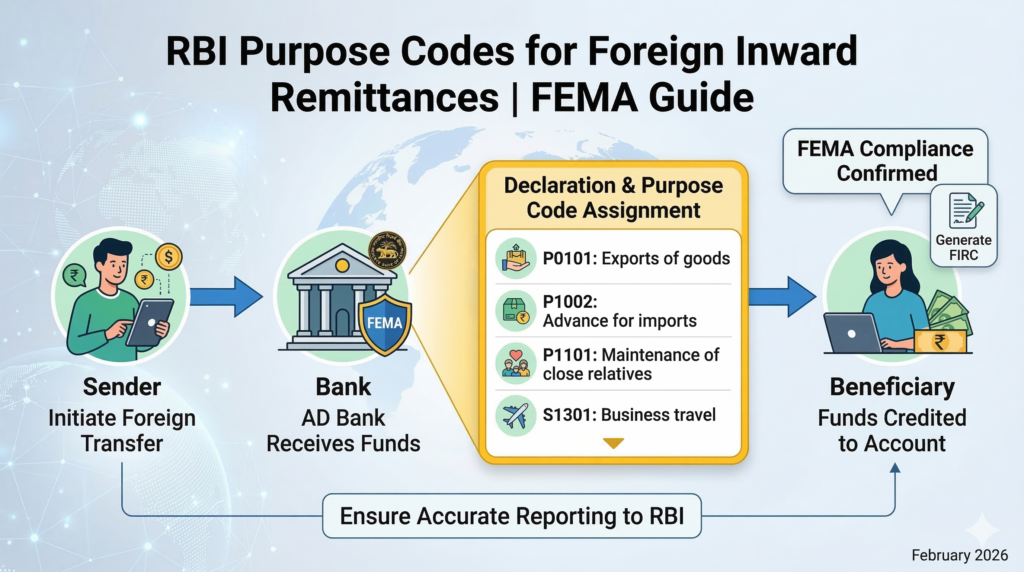
Purpose code classification
Each transaction must be tagged with a purpose code that defines its nature.
Purpose codes help regulators identify:
- Type of export activity
- Nature of payment received
- Applicable compliance category
Incorrect classification can lead to processing issues.
KYC and AML verification
Banks perform mandatory checks to ensure legitimacy of transactions.
These checks include:
- Verifying exporter identity
- Monitoring transaction patterns
- Flagging suspicious activities
While necessary, these checks can slow down processing if data is incomplete.
How Cross Border Payments Flow Into India
To understand delays and inefficiencies, exporters must understand how payments actually move.
Step-by-step transaction flow
A typical inward remittance follows this sequence:
- Client initiates payment from their bank
- Payment moves through international banking networks
- Intermediary banks process and route funds
- Currency conversion is applied
- Funds reach the authorized dealer bank in India
- Compliance checks are completed
- Final settlement is credited to the exporter
At each stage, delays or deductions may occur.
Where delays typically happen
While the process appears linear, delays often occur at specific points:
- During intermediary bank processing
- At the compliance verification stage
- During currency conversion
- Due to documentation mismatches
Understanding these points helps exporters reduce inefficiencies.
Common Operational Challenges Exporters Face
Even compliant exporters face practical challenges that affect payment timelines and clarity.
Limited visibility into payment status
Exporters often lack real-time tracking of their payments.
This leads to:
- Uncertainty about fund location
- Difficulty in estimating settlement time
- Increased dependency on bank communication
Manual reconciliation issues
Matching incoming payments with invoices is not always straightforward.
Challenges include:
- Partial payments
- FX differences in final amount
- Missing transaction references
This increases administrative effort.
Compliance-related delays
Even minor discrepancies in documentation can trigger delays.
Examples include:
- Invoice mismatches
- Incorrect purpose codes
- Missing supporting documents
These issues can hold payments for extended periods.
FX conversion unpredictability
Although not always visible, currency conversion timing affects final settlement.
This creates:
- Variability in received amounts
- Difficulty in revenue forecasting
- Margin inconsistencies
Improving Efficiency in Inward Remittance Handling
While compliance requirements cannot be removed, exporters can optimize how they handle payments.
Standardizing documentation workflows
Consistency in documentation reduces errors.
Best practices include:
- Using uniform invoice formats
- Aligning invoice details with payment references
- Maintaining digital records
Automating reconciliation processes
Automation helps reduce manual effort.
It enables:
- Faster matching of payments with invoices
- Reduced errors
- Better tracking of outstanding payments
Enhancing communication with banks
Proactive coordination with banks improves processing speed.
Exporters should:
- Track payment status regularly
- Respond quickly to queries
- Keep compliance documents ready
Using systems that simplify compliance
Modern systems integrate compliance into payment workflows.
This reduces:
- Manual intervention
- Processing delays
- Dependency on fragmented systems
Building a More Structured Payment Process
To scale effectively, exporters need a system that combines compliance, visibility, and efficiency.
Integrating compliance into operations
Instead of handling compliance separately, it should be embedded into daily processes.
This ensures:
- Faster processing
- Reduced errors
- Better alignment with regulations
Improving data visibility
Access to transaction-level data allows exporters to:
- Track payment progress
- Identify delays
- Monitor compliance requirements
Reducing operational friction
Streamlining workflows helps exporters:
- Save time
- Reduce administrative burden
- Focus on business growth
Conclusion
For Indian SME exporters, inward remittance is not just about receiving funds. It is a structured process shaped by regulatory requirements, banking systems, and operational workflows.
Managing cross border payments effectively requires a clear understanding of compliance, documentation, and transaction flow.
By learning how cross-border payments work in India and optimizing processes around visibility, standardization, and efficiency, exporters can reduce delays and improve financial control.
In an increasingly global marketplace, the ability to receive payments smoothly is not just a compliance requirement. It is a key driver of sustainable growth.
