

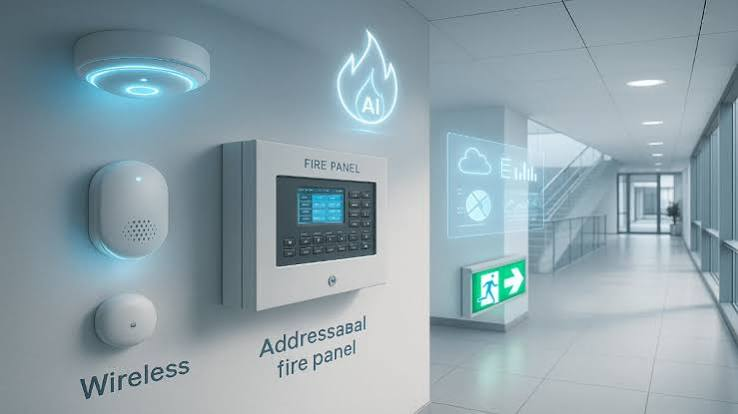
For decades, fire detection and physical security operated as entirely separate disciplines in commercial buildings. Fire panels lived in one corner of the mechanical room, access control servers in another, and video surveillance ran on its own network managed by a different contractor. Each system had its own maintenance schedule, its own software interface, and often its own team responsible for keeping it operational.
That model is under serious strain. As commercial buildings grow more complex — accommodating hybrid workforces, multiple tenants, 24-hour operations, and stricter compliance requirements — the gaps between disconnected safety systems have become operational liabilities. Response times slow. Alarms are misread. Incidents that cross the boundary between fire and physical security create confusion about who is responsible and what the correct response should be.
The shift happening across US commercial real estate is not primarily technology-driven. It is operations-driven. Facility managers, risk officers, and building owners are recognizing that maintaining separate safety infrastructures creates real costs — in staffing, in liability exposure, and in the quality of emergency response. What follows are seven concrete reasons that integrated systems are replacing the siloed approach, and why that transition is accelerating.
1. Separate Systems Create Response Gaps During Actual Emergencies
When a fire alarm activates in a building with siloed infrastructure, the fire detection system does its job — it alerts occupants and notifies the monitoring station. But if the incident involves a forced entry, a door that should be unlocked for evacuation, or a camera feed that could help emergency responders understand what they’re walking into, those systems are not automatically coordinating. They require manual intervention from separate operators, often working from different dashboards in different physical locations.
A well-configured integrated fire and security platform changes this dynamic by treating fire, access control, and surveillance as parts of a single response workflow rather than independent alarms. When a fire event triggers, the system can simultaneously release magnetic door locks on egress paths, isolate elevator access, begin recording on cameras nearest the event, and send a unified alert to a central monitoring team — without requiring a human to manually bridge those actions across three separate systems.
The Cost of Coordination Lag
In siloed environments, the time between a fire alarm activating and a security operator pulling up the relevant camera feeds can range from several minutes to longer depending on staffing levels and shift timing. During an actual emergency, that lag has real consequences. Evacuation routes may remain locked. Elevator recall may be delayed. Security footage relevant to the cause of the incident may not be preserved correctly. These are not hypothetical concerns — they are documented failure patterns in post-incident reviews conducted by fire marshals and insurance investigators following commercial building emergencies.
2. Dual Maintenance Contracts Accumulate Hidden Costs Over Time
Organizations with separate fire and security systems typically maintain separate service contracts, separate testing schedules, and separate vendor relationships. On the surface, this appears manageable. In practice, it creates redundant administrative overhead and regularly produces situations where the two vendors point at each other when a problem crosses system boundaries.
What Consolidation Actually Changes
Moving to a unified infrastructure under a single service relationship does not simply reduce the number of invoices. It changes the accountability structure. A single provider responsible for the full system has a clearer obligation when something fails. There are no hand-offs between vendors when a door release tied to a fire alarm does not function correctly during a test. The testing itself becomes more comprehensive because it covers the integration points — the exact locations where siloed systems most often fail.
3. Compliance Requirements Are Increasingly Written Around Integration
Building codes and fire safety standards in the United States are not static. The NFPA 72 National Fire Alarm and Signaling Code has been progressively updated to address how fire alarm systems interact with building control systems, access control, and emergency communication infrastructure. Jurisdictions across the country are adopting these revisions, and inspectors are increasingly evaluating whether safety systems are coordinated, not just individually functional.
How Siloed Systems Fail Inspections
A building that has a compliant fire detection system and a compliant access control system, but no documented or tested integration between them, may still fall short of what inspectors expect in jurisdictions that have adopted updated code language. The failure is not in either individual system — it is in the gap between them. Integrated architectures, by design, create documented and testable coordination points that align with the direction compliance frameworks are moving.
4. Workforce Reductions Require Systems That Do More With Less Human Oversight
Many commercial building operators are running leaner facilities teams than they were ten years ago. Contract security staffing levels have been adjusted. On-site engineering teams have shrunk. The assumption that a trained operator is always available to manually coordinate between a fire panel and a security console is no longer reliable across all shift types and property sizes.
Automation as an Operational Requirement
Integrated systems allow building operators to define automated response sequences that execute without requiring a human to initiate each step. This is not about replacing human judgment during complex emergencies. It is about ensuring that the mechanical and access-related responses — door releases, elevator recalls, HVAC isolation — happen immediately and correctly even when staffing is minimal. For a property manager overseeing multiple buildings remotely, this kind of automated baseline response is the difference between a controlled incident and one that escalates before anyone has a chance to intervene.
5. Incident Investigation Becomes Substantially More Reliable
After any significant safety incident — whether it results in injury, property damage, or regulatory scrutiny — the investigation process requires pulling together evidence from multiple systems. In siloed environments, fire alarm event logs, access control entry records, and surveillance footage each exist in separate databases, often with different timestamp formats and different retention policies. Correlating these records manually is time-consuming and introduces the possibility of alignment errors.
Unified Logging and Its Practical Value
An integrated platform maintains a single event log that captures fire system activations, door access events, camera triggers, and operator actions in a synchronized timeline. When an investigator — whether internal, insurance-related, or from a regulatory body — needs to reconstruct what happened and in what sequence, that unified log provides a clear, unambiguous record. This is not a minor operational convenience. For organizations that face post-incident liability questions, having clean, correlated records from a single system is a meaningful risk management advantage.
6. Tenant Expectations in Multi-Occupancy Buildings Have Shifted
Commercial tenants — particularly those in healthcare, financial services, legal, and technology sectors — are increasingly asking detailed questions about building safety infrastructure before signing leases. These are not general questions about whether a building has a fire alarm. They are specific questions about how safety systems communicate, how incidents are monitored, and whether the building’s infrastructure meets the standards their own risk and compliance teams require.
Safety Infrastructure as a Leasing Factor
Building owners in competitive commercial real estate markets are discovering that integrated safety infrastructure has become part of the conversation alongside HVAC quality, energy ratings, and floor plate efficiency. A building that can demonstrate a unified, tested, and professionally monitored integrated fire and security system is in a stronger position when tenants in regulated industries are evaluating their options. Conversely, buildings with clearly fragmented safety systems are encountering resistance from prospective tenants whose legal and risk teams flag the operational gaps during due diligence.
7. Cyber Exposure Grows When Security and Fire Networks Remain Separate
Modern fire alarm panels, access control systems, and surveillance infrastructure all run on networked hardware. In siloed environments, each of these networks was typically managed by a different contractor with different patch cycles, different firmware update schedules, and different levels of attention to network hardening. This creates a fragmented cybersecurity posture across the building’s operational technology systems.
Unified Network Management Reduces Attack Surface
When integrated fire and security infrastructure is deployed under a unified architecture, network management consolidates. Firmware updates, access credentials, and monitoring for unusual traffic patterns can be handled as part of a coherent operational technology security program rather than managed across three separate contractor relationships. For building operators who are subject to cybersecurity requirements — or who simply recognize that networked physical security systems are increasingly targeted — this consolidation represents a meaningful reduction in exposure. A single point of architectural oversight is easier to audit, easier to update, and easier to defend than a collection of independently managed networks that rarely communicate.
Closing Perspective: Why the Transition Is Happening Now
The movement away from siloed fire and security infrastructure is not happening because the technology has suddenly become more sophisticated. The underlying components — panels, sensors, cameras, access readers — have been capable of integration for years. What has changed is the operational reality around those buildings. Leaner teams, stricter compliance, more complex tenancy arrangements, and growing cybersecurity awareness have all made the cost of maintaining separate systems more visible and more difficult to justify.
Facility managers and building owners who are evaluating their current infrastructure should not approach this as a wholesale replacement project. Many integrated deployments begin with a specific coordination problem — evacuation door releases that do not respond reliably to fire events, or investigation records that cannot be correlated cleanly — and expand from there as the operational benefits become clear.
The question for most commercial building operators is no longer whether integrated safety infrastructure makes sense. It is where to begin and how to manage the transition without disrupting operations that depend on the current systems, however imperfect, continuing to function during the process. That is a planning and scoping challenge, not a conceptual one. And it is one that the industry is increasingly experienced in solving.
