

A new idea often starts with something very small.
It might be a sketch on a piece of paper, a screenshot saved on a phone, a character someone imagines while watching a movie, or a simple image generated during a brainstorming session. The idea may be clear in someone’s head, but turning that idea into something three-dimensional has traditionally required quite a few additional steps.
This gap between having an idea and making something tangible is one of the challenges AI 3D generation is beginning to address.
Instead of requiring creators to build every object manually from the beginning, AI 3D tools can use images and other visual references as starting points. The result can then become something to inspect, modify, print, share, or develop further.
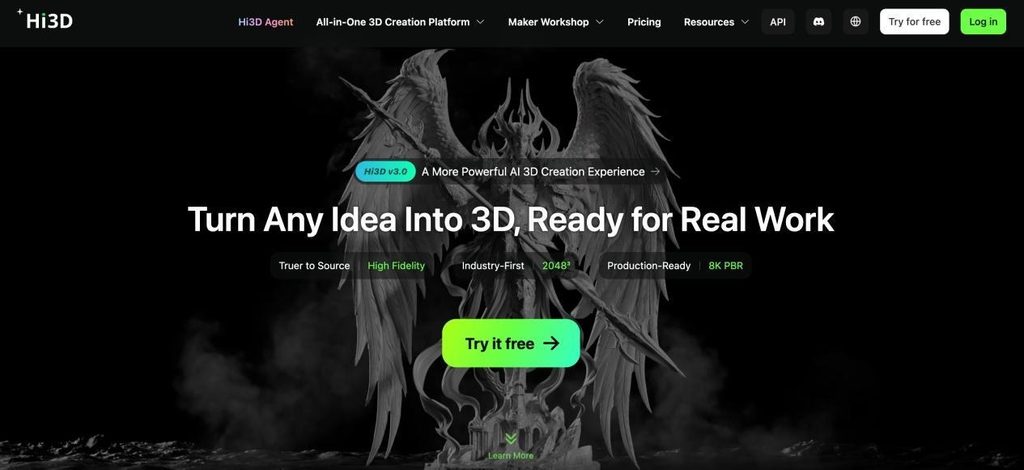
Hi3D is built around this transition from visual inspiration to usable 3D content. Its platform combines image-to-3D generation with tools for textures, reliefs, model splitting, multi-color printing, and image generation.
The interesting part is not simply that AI can create a 3D model. It is that the technology can shorten the distance between imagining something and actually working with it in three dimensions.
The Long Journey From an Idea to a 3D Object
Traditional 3D creation usually begins with a blank scene.
For an experienced 3D artist, this is not necessarily a problem. Professional modeling software provides enormous control over geometry, materials, lighting, and other details. But that control also means that creators need to make many decisions before a finished object begins to take shape.
Consider someone who wants to create a small collectible based on an original character.
The character may already exist as a drawing. The creator knows what the face should look like, what clothes the character wears, and what the overall silhouette should be.
Yet the drawing is still flat.
To turn it into a 3D asset, someone needs to interpret the character’s proportions, construct the geometry, establish depth, and eventually add surface details.
For a professional 3D artist, this can be part of the job. For an independent creator, hobbyist, designer, or someone simply testing an idea, the technical barrier can make experimentation difficult.
AI 3D generation approaches the problem from a different direction.
Rather than asking the creator to start with geometry, it allows the creator to start with a visual reference.
That small change can make the creative process feel very different.
Images Can Become the Beginning of the 3D Process
Hi3D’s image to 3d model workflow supports JPG, PNG, and WEBP images, with individual images up to 20 MB. It supports both single-view and multi-view generation, with multi-view input accepting two to four images and requiring a front view.
This means that a creator does not necessarily need to prepare a traditional 3D scene before experimenting with an idea.
A photograph can become a starting point.
A drawing can become a starting point.
A concept illustration can become a starting point.
Even a visual reference created specifically to explore an idea can become part of the process.
Multi-view input can provide additional information when a single image does not fully describe an object. Additional front, back, left, or right views can give the system more information about the object’s structure and appearance.
This is particularly relevant to creative work because ideas are often expressed visually before they are expressed technically.
The creator may know what something should look like long before knowing how to model it.
AI can help bridge those two stages.
The Creative Process Becomes More Iterative
One of the biggest changes brought by AI-assisted creation is the possibility of treating the first model as a starting point rather than a final answer.
This is important because creative work rarely follows a perfectly linear process.
A designer may create something and decide that the proportions are wrong.
An artist may discover that a character looks better with a different silhouette.
A hobbyist may realize that an object needs to be simplified before it can be physically produced.
In a traditional workflow, every new direction may require substantial manual work.
With AI-assisted generation, the early stage can become more exploratory.
A creator can ask:
What if the shape were different?
What if this reference became a physical object?
What would this design look like from another angle?
Would this idea work as a collectible?
Could this image become something I can actually hold?
These questions are difficult to answer when an idea exists only as a flat image.
A 3D representation makes them easier to explore.
From Visual Concept to Something You Can Inspect
A major benefit of 3D is that it changes how people evaluate an idea.
A two-dimensional image has a fixed viewpoint. A 3D model can be examined from different angles.
That matters even for simple objects.
A shape may look balanced from the front but appear too deep from the side. A character may have an appealing silhouette but awkward proportions when viewed from another direction. A decorative object may look impressive in an illustration but become difficult to reproduce physically.
These discoveries can happen earlier when an idea is represented in 3D.
The model therefore becomes more than an output.
It becomes a way of asking better questions about the original idea.
This is one reason AI 3D generation can be useful even when the generated model is not intended to become the final production asset. A preliminary model can reveal problems, inspire changes, or simply help a creator decide whether an idea is worth developing.
Detail Matters When the Idea Depends on Small Features
As AI 3D generation becomes more sophisticated, the focus is shifting from simply producing recognizable shapes to preserving finer details.
Hi3D’s V3.0 generation system uses 2048³-level geometry generation and supports up to 8K textures. The company describes the system as being designed to retain small structures, patterns, text, and other fine details.
This matters because many creative concepts are defined by details rather than overall shape.
Think about a small figurine with an intricate costume.
The general body shape may be easy to recognize, but the patterns on the clothing, small accessories, engraved details, or facial features contribute to the identity of the design.
The same principle applies to decorative objects, jewelry concepts, branded items, and other visually detailed creations.
Higher-detail generation gives creators more room to explore these characteristics before moving further into the production process.
Of course, the appropriate level of detail depends on the intended use. A quick concept may not require a highly detailed model, while a collectible or detailed digital asset may benefit from it.
When the Same Idea Needs Different Visual Styles
Not every creative project aims for realism.
Some creators want realistic materials. Others prefer something more illustrative, exaggerated, or stylized.
This is where surface appearance becomes an important part of the creative process.
Hi3D includes a Stylized Texture feature designed to add realistic or stylized textures to 3D models.
This makes it possible to think about a 3D object not only in terms of geometry but also visual identity.
The same basic form could potentially support different creative directions.
A product concept might be presented with a realistic material.
A fantasy character could use a more stylized appearance.
A decorative object could be given a surface treatment that emphasizes its artistic qualities.
This distinction is useful because shape and appearance are often developed together. A creator may understand the design differently once the object has a material and texture rather than appearing as a plain gray mesh.
Not Every 3D Idea Needs to Become a Full Object
There is another interesting possibility in the transition from 2D to 3D: sometimes a creator does not need a complete three-dimensional object at all.
A flat image can instead become a relief.
Relief models sit somewhere between two-dimensional artwork and fully volumetric 3D objects. They can preserve the visual character of an image while introducing physical depth.
Hi3D provides an Image to 3D Relief capability that can convert images into 3D relief models, with supported outputs including formats such as STL, GLB, 3MF, PNG, and EXR depending on the workflow.
This creates another path from digital artwork to physical creation.
A photograph, illustration, logo, or decorative design does not always need to become a complete 3D object. In some cases, turning its visual information into raised or recessed geometry may be a better fit.
This expands the meaning of “image to 3D.”
It does not have to mean turning every picture into a conventional 3D model.
It can also mean finding a new physical form for visual information.
Making Large Ideas More Practical
There is also a practical side to turning digital ideas into physical objects.
A model may look perfect on a screen but be too large for the available 3D printer, leaving creators wondering how to split 3D model for printing. Instead of abandoning the design, creators can divide it into smaller sections.
Hi3D’s Split-to-Print feature is designed to split a 3D model into printable parts and add connectors for assembly.
This is an example of how the digital and physical sides of creation are connected.
Generating the model is only one part of making something.
The physical world has its own constraints: printer size, assembly, materials, color, and other considerations.
A useful AI 3D workflow therefore needs to account for what happens after generation.
For creators, this means an idea does not have to stop at a digital preview.
It can continue toward a physical prototype, collectible, decorative object, or other tangible result.
Color Can Become Part of the Physical Creation
Color is another area where the gap between digital design and physical production becomes visible.
A 3D model may contain multiple colors on screen, but reproducing those regions physically requires a suitable workflow.
Hi3D’s Multi-color Print capability creates printable color regions and allows control over the number of colors.
This can be useful for projects where color is part of the identity of the object.
A character’s clothing may depend on several distinct colors.
A decorative piece may contain a repeating pattern.
A branded object may require recognizable color regions.
A prototype may use different colors to distinguish parts.
Instead of treating color as something that only exists in a digital render, multi-color workflows can help bring that visual information into the physical object.
AI Can Also Help Before the 3D Model Exists
Interestingly, the creative process does not necessarily have to begin with an existing image.
Hi3D also provides an Image Generation feature that can start from a sentence and generate an inspiration image for a 3D creation.
This creates a different type of workflow:
text → image → 3D
Rather than starting with a photograph or finished illustration, a creator can first explore an idea visually.
For example, someone might have a vague concept for a futuristic ornament, a fantasy creature, a miniature environment, or a stylized collectible.
Instead of immediately trying to model the object, they can first establish its visual direction.
Once the concept image feels closer to the intended idea, it can become a reference for the next stage of 3D creation.
This makes the process feel less like traditional modeling and more like a chain of creative translation:
idea → visual concept → 3D representation → physical or digital creation
One Idea Can Lead to Many Different Outcomes
An interesting consequence of this workflow is that the same starting idea does not have to produce the same kind of final result.
A single concept image could lead to:
- A digital 3D asset
- A 3D-printed prototype
- A collectible
- A relief model
- A stylized object
- A multi-color physical model
- A starting point for further 3D editing
The technology therefore becomes less about a single “generate” button and more about expanding the number of directions a creator can take.
This is especially relevant for independent creators.
Large studios often have dedicated specialists for modeling, texturing, prototyping, and production. Individual creators may not have access to the same resources.
AI-assisted tools can provide a way to experiment with parts of that workflow without requiring every creator to become an expert in every technical discipline.
What Human Creators Still Bring to the Process
The rise of AI 3D generation does not make human creativity irrelevant.
If anything, easier generation places more emphasis on creative decisions.
AI can produce a model from a reference, but a person still needs to decide whether the result fits the original idea.
Should the shape be changed?
Should the proportions be exaggerated?
Does the texture match the intended style?
Is the model suitable for the intended purpose?
Should the object be printed at all?
These are creative decisions rather than simple generation tasks.
The role of the creator can therefore shift from manually constructing every part of the model toward directing, evaluating, refining, and combining generated results.
That is a meaningful change in the creative process.
A New Relationship Between Imagination and Making
For a long time, there has been a noticeable gap between imagining a three-dimensional object and actually creating one.
You could have an idea without knowing how to model it.
You could have a drawing without knowing how to turn it into geometry.
You could have a concept without having the technical resources to build a prototype.
AI 3D generation does not remove every challenge involved in making something. But it can make the first transition easier.
Hi3D brings together image-to-3D generation, high-detail models, textures, image generation, relief creation, model splitting, and multi-color printing within one creative environment.
That combination reflects a broader change in how 3D creation can work.
The process does not always have to begin with technical modeling skills.
It can begin with an idea.
A picture.
A sketch.
A reference.
A sentence.
From there, AI can help turn that starting point into something that can be viewed, explored, modified, shared, and potentially made physical.
And perhaps that is the more important story behind AI 3D generation: not simply that machines can create models, but that more people can move from “I have an idea” to “I can actually make something with it.”
